
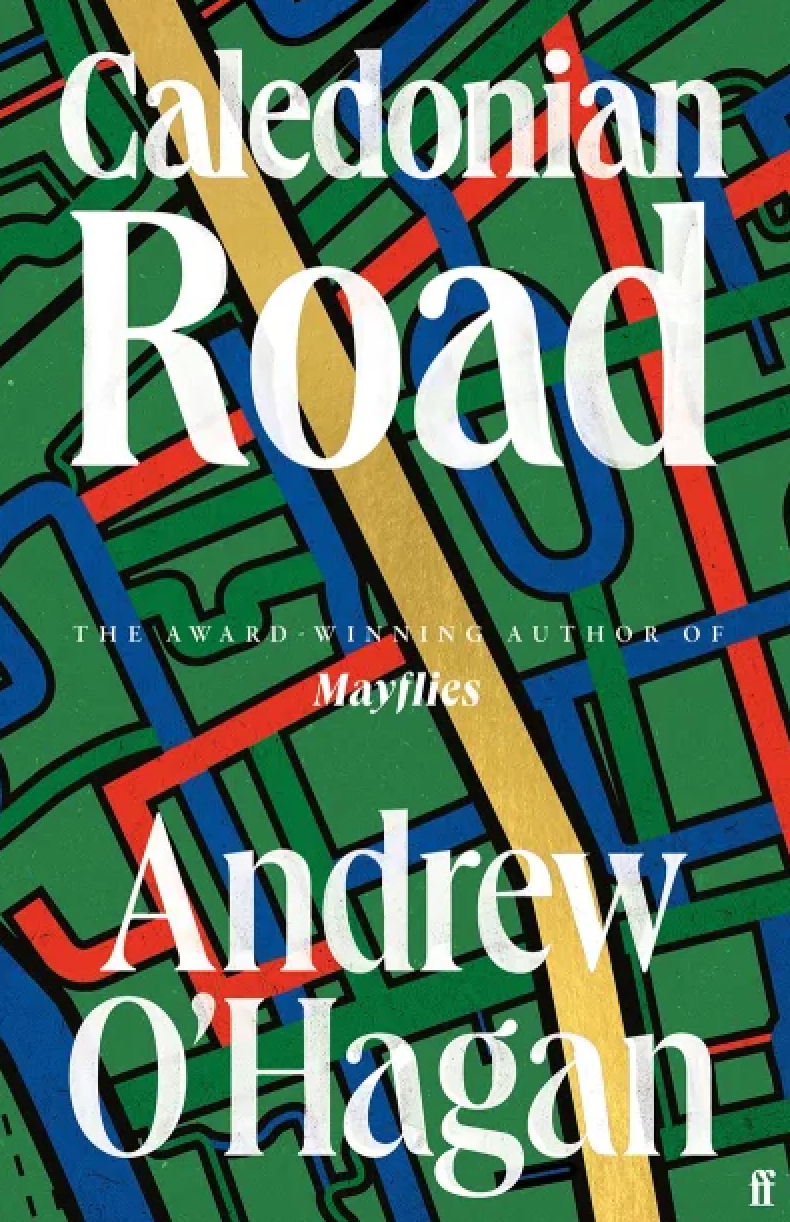
I was very happy to stumble upon Caledonian Road by Andrew O’Hagan at one of my local libraries, while not particularly looking for it. An earlier novel by O’Hagan, Mayflies, is one of my favourite novels of recent years, a beautiful and very moving story of male friendship over the decades. This is one of the things I love about using libraries: there’s always an element of chance to what you might find.
The first thing that caught my eye about Caledonian Road was not just the author’s name on the front, but its sheer heft. The hardback copy I took out from the library came in at over 600 pages. At the front is a helpful explainer of characters, with over 60 listed. From this, it should become clear that this is an ambitious novel for which the word “sweeping” might probably apply.
And this is a broadly correct assumption.
Caledonian Road is a classic ‘state of the nation’ novel, but in this case, it’s more “the absolute state.” The world it showcases attempts to be glamorous and beguiling, but instead looks utterly facile and grotesque. We see it through the eyes of a celebrity academic and author, Campbell Flynn, a man who at times seems completely at home in this world, at others, completely bewildered. He appears to have it all – a strategic marriage to talented aristocrat, a beautiful Georgian townhouse in Islington and a country pad in Suffolk, two successful if confusing children, and a highly succesful career of his own. He’s come a long way from his roots in a Glasgow council flat.
That social climbing is at the root of Caledonian Road. Flynn’s rise seems effortless, but it is in fact a product of patronage. What was freely given, could so easily be taken away. This being a novel, we might well assume that Flynn is heading for a fall.
This is a dizzying world of performatively acerbic newspaper columnists, Russian playboy sons of oligarchs, actors, and film directors. Campbell’s own son is a celebrity DJ and full-time party-boy.
Elite London of the 2020s is a criminal playground, sleazy and unpleasant, hiding behind of a veneer of sophistication. It’s a world that’s bought and sold by Russian money, and tedious men in shiny suits follow their basest instincts. Everyone knows everyone: the gilded hard-right “populist” politicians, the Russian money men, the aristocrats, the newspaper editors, the art dealers, and people traffickers.
O’Hagan captures this world in prose that feels light and natural. With so many characters there’s always the risk that some will dissolve into caricature, but that rarely happens. There is a note or two of the Dickensian OTT about some of the book, but the author knows when to reign it in.
I was unsure how I felt about Flynn. While it was easy to reach a conclusion about many of the characters, Flynn felt more slippery. He reflects on his own position in the strange world in which he’s found himself as a “liquid presence”, and during his more downbeat moments fears he’s an interloper or a fraud. In the basement, is his problem sitting tenant Mrs Voyles, complaining of damp, rats, and bad plumbing, gives him a perpetual nagging headache. The spiky real world just won’t leave you alone.
There’s so much going on in Caledonian Road that it’s easy to get lost. I found it an enjoyable read, but at times a little dispiriting. If I’m honest, I found it hard to find much sympathy for any of the characters. It didn’t move me, but it did impress me with the author’s technical execution and artistic vision.
The world it described felt fragmented and confused, without much of a moral anchor. It was hard to see anything of worth emerging from these circles, either culturally or politically. Another problem is that the people and the lives it describes are not particularly interesting, despite their wealth and jaundiced importance. We know what they think, how they act, and who they are.
But that isn’t the fault of the author, who has done an incredible job shining a light on the unedifying state of the not particularly great and not that good, in a country without a purpose.

Leave a Reply